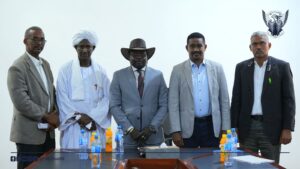
?Kamil Idris: Between a Civilian Facade for Military Rule and Promises Without Funding – Where Is the Legitimacy and Where Is the Capability

Dr. Ahmed El-Tigani Sidahmed
In a time when internal and external forces are converging on what remains of the homeland, the appointment of Dr. Kamil El-Tayeb Idris as Prime Minister in Khartoum, under the banner of the military establishment and at the behest of the dissolved Islamist National Congress Party, raises serious questions — not about his academic degrees or international experience, but about his legitimacy and realism in leading a Sudan he scarcely knows and to which he was never elected. More importantly, it raises questions about the extent of his submission to a regional axis led by Egypt (and fueled with weapons and repression by Iran, Turkey, and the micro-state of Qatar), which works systematically to weaken Sudan so that it remains a backyard without sovereignty or a national project.
First: Appointment Without Legitimacy… A Facade Without a Mandate
Kamil Idris was appointed Prime Minister on 19 May 2025 by a unilateral decision of General Abdel Fattah Al-Burhan, at a pivotal moment in the civil war between the army and the Rapid Support Forces. His selection did not come through a popular election, nor through consensus among revolutionary forces, nor even via a new peace agreement. It was a move aimed at beautifying the face of a military de facto authority seeking to rehabilitate itself in the eyes of the outside world¹.
Despite attempts to market him as a balanced civilian alternative, credible international analyses have described the appointment as “a soft facade” for a violent military trajectory². One such analysis noted: “The goal is to absorb international pressure by giving a civilian veneer without any real change in the structure of power.”
Second: A Position Besieged by the Old Regime’s Remnants and Regional Intelligence
The challenges facing Kamil Idris were not merely administrative, but deeply political. Immediately upon taking office, he announced the dissolution of his interim cabinet and began consultations to form a new one. Confirmed reports indicated that some of the forces consulted included influential figures from the defunct regime — particularly Islamist factions that had repositioned themselves in eastern Sudan³.
At the same time, the Egyptian role cannot be overlooked. The support the army leadership receives from Cairo has become blatant, both politically and in intelligence terms. This raises fears that Kamil Idris not only lacks genuine executive authority, but may be entirely subject to the dictates of an external axis that views Sudan as a sphere of influence, not as a sovereign partner⁴.
Third: A Professional Record That Does Not Erase Ethical Controversy
There is no doubt that Idris is an international figure with an impressive academic record, having held senior positions at the United Nations and serving for years as Director General of the World Intellectual Property Organization (WIPO). However, this record was marred by a notorious case in 2007, when UN investigations revealed that he had provided different birth dates in his official documents. No criminal charges were proven, but the incident was a blow to his credibility and, under U.S. and international pressure, he was forced to resign before the end of his term⁵.
Subsequent accusations of misusing the organization’s resources for personal purposes further reinforced the perception of administrative laxity and raised questions about his conduct when holding power without independent oversight⁶.
Fourth: The “Marshall Plan ”… A Scheme Without Funding
Since his appointment, Idris has promoted what he calls “Sudan’s Marshall Plan,” inspired by the American model of rebuilding Europe after World War II. He spoke of a comprehensive development program to revive Sudan economically and socially, claiming it had already been submitted.
However, closer examination reveals that what Idris calls the “Marshall Plan” is nothing more than a personal vision published on his official website and in a book he authored⁷. There is no evidence of its adoption by any international donor entity such as the World Bank, the European Union, or the IMF. There are also no funding commitments, implementation timelines, or actual partner institutions.
Thus, presenting this scheme in political discourse without a realistic financial foundation amounts more to political marketing than to a serious work plan — especially amid institutional paralysis and infrastructure destroyed by war.
Fifth: The Promises of Khartoum Airport and a “Returning” Government
In July 2025, Idris stated that Khartoum Airport would be operational again before year-end, and that the executive government would gradually return to the capital. This ignores the reality of two rival governments — one backed by the army, and the other a consensual, community-based, unifying, peaceful administration led by the Founding Alliance (TASIS). It also overlooks the fragility of security in the capital, the ongoing aerial bombardment, and mass displacement.
Without a comprehensive ceasefire, a restructuring of authority, and a genuine national political consensus, all these promises of return amount to little more than words over the rubble of cities⁸.
A Cautionary Conclusion: The Wrong Man at a Defining Moment
Kamil Idris’s experience to date reveals sharp contradictions: an appointment without a mandate, a plan without funding, and rhetoric without domestic grounding. The danger is heightened if his presence ultimately serves to mask an ideologically-driven military rule supported from abroad, rather than marking a step toward independence and sovereignty.
The imperative now is to warn against building Sudan’s future on false civilian facades, unfunded promises, and submission to axes that still see this homeland as a corridor — not a state with agency.
Dr. Ahmed Eltigani SIDAHMED
Founding Member of the Sudanese Founding Alliance (TASIS)
8 August 2025 – Rome, Italy
References:
- Washington Post: https://www.washingtonpost.com/archive/politics/2007/10/02/wipo-chief-admits-to-falsifying-age
- The Washington Institute – Analysis: ‘Kamil Idris and the Illusion of Civilian Leadership’ – www.washingtoninstitute.org
- Africa Confidential, June 2025: Cabinet appointments and Eastern Bloc influence – www.africa-confidential.com
- Majalla Report: Egypt’s Role in Sudan – www.majalla.com
- Reuters: ‘WIPO head resigns amid credibility controversy’ – https://www.reuters.com/article/idUSL19962692
- UN Oversight Reports on WIPO internal audit, 2007–2008.
- Official site of Kamil Idris: Sudan’s Marshall Plan – www.kamilidris.org
- Al-Raya News (July 2025): Idris’s statements on return to Khartoum – https://alrayanews.net/82808